
Condensed Matter Physics
Exploring strongly correlated systems and quantum many-body physics
Strongly Correlated Condensed Matter and Quantum Many-body Physics
-
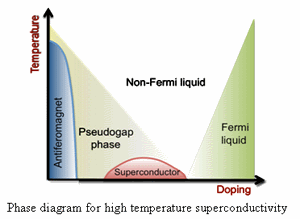
Strongly correlated condensed matter systems include high temperature superconductors, quantum Hall systems, and quantum magnets. In addition to the possibility of practical applications, strongly correlated condensed matter physics has been an important branch of physics due to the introduction of the fundamental concept called "emergence."
-
Numerical computations are an essential part of strongly correlated condensed matter physics. In strongly correlated condensed matter systems, inter-particle interaction energy is either comparable or stronger than the kinetic energy scale of the problem, in which case the usual perturbation theory cannot be applied.
"How do we make progress when there is no reliable perturbation theory?"
Numerical Computations in Strongly Correlated Condensed Matter Physics
Trial Wave Function and Quantum Monte Carlo Simulation
-
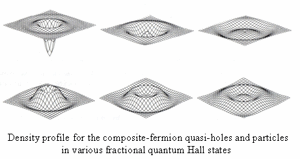
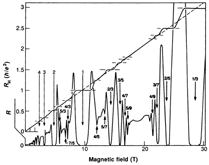
Go back to the basics and try to make an educated guess for what would be the ground state of the problem.
-
Transform the quantum problem to the classical statistical-mechanics counterpart and borrow numerical techniques developed there.
Exact Diagonalization (Lanczos Algorithm)
-
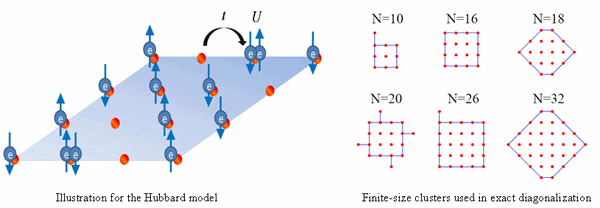
Get the exact solution by exactly solving the problem in finite size systems and use the obtained insight to investigate thermodynamic properties.
Dynamical Mean-Field Theory
-
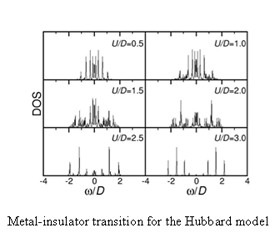
Assuming that the temporal fluctuation is much more important than the spatial counterpart, approximate the full lattice problem as that of the quantum impurity interacting with a surrounding bath.
Computational Methods
Quantum Monte Carlo
Statistical sampling for many-body quantum systems
Exact Diagonalization
Lanczos algorithm for finite systems
DMFT
Mean-field approach for correlated systems